

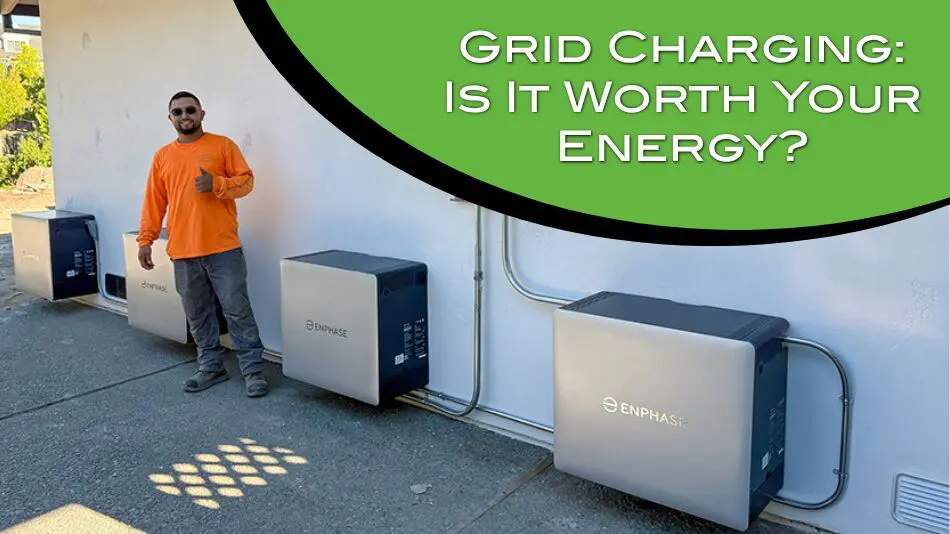
Should You Charge Your Battery from the Grid?
A home battery is built to protect you from peak rates and outages—and to give you power on your terms. But what happens when the battery runs low? Before you reach for the grid, here’s what you should know.
What Is Grid Charging?
Grid charging means buying electricity from your utility to fill your battery, instead of using solar energy to do it. That electricity is not free. Every kilowatt-hour you pull from the grid is billed according to your rate schedule.
Batteries also lose a little energy each time they charge and discharge, so you always buy more than you get back. Another fact worth knowing: when the grid is down, it can’t charge your battery at all. During an outage, only solar can refill it.
Is Grid Charging Right for Me?
Here are the common pros and cons, depending on your setup.
| Your Setup | Pros of Grid Charging | Cons of Grid Charging |
|---|---|---|
| Battery Only, No Solar |
|
|
| Solar and Battery |
|
|
The Bottom Line
If you have solar, let the sun do the charging. Paying the utility to fill your battery adds usage to your bill, loses some energy along the way, and can be a violation of your signed NEM agreement with the utility company.
If you don’t have solar, the only way to charge your battery is through grid charging, so in that instance, grid charging is necessary. But it isn’t the best long-term answer. Adding solar lets the sun do the charging, so your battery refills for free—even during an outage.
Ready to Let the Sun Do the Work?
Schedule A Consultation
Recent Posts








Recent Projects